
Cedar Care and Wet Weather

Cedar Care and Wet Weather

4 Jul 2025
Cedar care and wet weather

One of the most common questions we get asked is “Can I get my Cedar maintained in the winter?”

Absolutely! With winter, comes rain…but not as much as you might think.

At the height of the wet season, there are 19.1 rainy days in June and 20 in August. In summer, there are 14.1 rainy days in December and 9.8 days in February. That’s only 6-10 days difference.

Yes, Auckland is a rainy place! But we’ve been looking after Cedar for 12 months of the year, for over 30 years, and rain isn’t as big of a problem as you might think.

This comes down to the unique properties of Cedar and how we care for it.

Oil and Stain Are Not Paint

The statement above may seem obvious, but the idea of paint drying is so fixed in our collective minds that people often make the comparison.

Aside from both being applied to walls, they couldn’t be more different products.

Paint is applied by building a film on the surface of another film, which then must dry and cure.

Stain and oil penetrate into the pores of the Cedar and start providing protection against moisture almost immediately.

You could even spray the boards lightly with a hose 20-30 minutes after application and it would make no difference to the finish.

How Wet is Wet?

Similarly, in most people’s minds, when a board gets wet, it is wet the whole way through. This is only what our eyes are telling us.

In truth, it’s only the surface that gets wet (usually the top 1mm), the rest of the board stays perfectly dry.

To apply a Cedar coating, we only need the surface of the board to dry out. Depending on exposure to the sun, wind and air temperature, this can happen anywhere between 5 – 30 minutes.

You can feel whether Cedar it is dry or not by touching the boards. If the surface is too wet, we simply do not apply the coating.

Mark likes to use the analogy of hanging out washing. If you are happy to put out your washing to dry, you can coat Cedar.

And if a spattering of rain does get onto the surface, the oil or stain is already working to create a barrier against moisture.

What Happens if it Does Rain?

Every morning, the Senior Technicians assigned to the job will look at the weather and work with the Production Manager to make the call. In most cases, the decision has been made the previous day.

Our scheduling team also looks at the weather in advance and plans accordingly. If rainy weather is on the way, they will book in other work such as washing or adapt the scheduled work to the conditions.

If the weather is inclement, the technicians can focus on areas of the house away from the wind and rain.

If the weather is coming from the north, we can coat the areas on the south, or undercover areas.

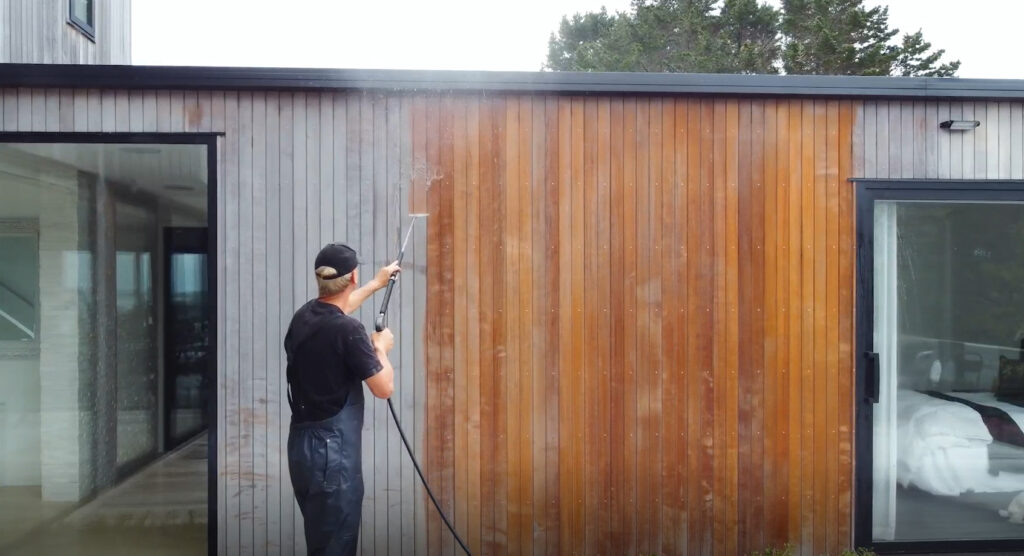
If rain is truly setting in, we can wash the Cedar in preparation for coating. During periods of persistent rain, there can be a gap of 1-2 weeks between washing and coating, but this could be left up to 6 weeks without any issues.

So, When is the Best Time to Coat?

The answer is always now. If you ask us in 6 weeks or 6 months, the answer will be the same.

We are battling the sun here, and the sun always wins. New Zealand’s harsh UV rays are constantly sucking the natural tannins from the boards and they need to be coated to protect against the wet-dry-wet effect.

If left longer than the recommended 2-3 summers, the surface can begin to roughen and create a toe-hold for mould and lichen, resulting in an unkempt look.

This isn’t scaremongering. If you leave them for another 6 months, the difference is almost indiscernible. But that doesn’t change the fact that there is no “best time” for Cedar maintenance.

The best time is always now. You just need to pick your days.

Final Thoughts

We have been doing this for over 30 years and know our way around a bit of rain.

If the boards are dry, we can coat them. Once we get to the point where the boards are wet and will not dry, we stop. Simple as that.

Don’t let the idea of rain put you off getting your Cedar maintained and protected. Winter is just as good as summer, and autumn is just as good as spring. The sun never stops and neither do we!


Does Your Cedar Need Help?

Our Free Cedar Assessment will assess the health of your timber and give expert advise on how to keep it looking beautiful for years to come.

Read More Articles

15 Apr 2024
In this article, we are looking at how to protect the value of your Cedar home - often your biggest asset - especially when the market is so volatile and uncertain.

The benefits of Cedar maintenance fall into two main categories: beautification and protection.

Beautification means making your Cedar look beautiful all year round. If sun exposed areas are left without replenishing the oils, the Cedar can start to look worn and tired. By adding oil back into Cedar, you are protecting it from the harsh New Zealand sun and restoring the natural vibrance of the timber. 

Protection means maintaining the integrity of the timber, so you don’t have to replace the Cedar in the future. Protection can also mean protecting your investment, both to maintain the value of what you just bought, or to improve the asking price if you are about to sell. 

In this article, we are looking at how to protect the value of your Cedar home – often your biggest asset – especially when the market is so volatile and uncertain. 

For some additional insight into the housing market, we are joined by Rachel Readhead from Barfoot & Thompson. 

Why Protect Your Cedar

People often think that if their Cedar looks tired, it needs to be maintained or restored, but that is not necessarily true. Cedar is a very resilient timber.

If not maintained in the short term, sun exposed areas will get damaged by the harsh UV rays and end up looking rather shabby. Not ideal, but not the end of the world either. 

If not maintained in the long term – we are talking 20+ years here – the Cedar may cup or warp, no longer protecting the outside of the house. The ultimate cost will be to replace the Cedar cladding on sun exposed faces, which is considerably more expensive than regular maintenance. 

“If the Cedar has started to warp or crack, it will raise red flags when the property report gets done. When doing a CMA [comparative market analysis] on the property, everything is taken into account,” said Rachel.

Return on Investment

When considering the cost of Cedar maintenance or restoration, there are two questions you need to consider.

  1. What do I have to spend so that I never have to replace my Cedar?
  2. Do I also want the Cedar to look beautiful all year round?

The average restoration price for a 3-bedroom home is $6.5k. After the initial restoration, sun exposed areas need recoating every 2-3 summers. The cost of regular maintenance comes down to around $2.5-5k, depending on the house size and build. 

If your Cedar is already in good condition and you want to maintain the value over the long term, you will need to recoat sun exposed areas every 2-3 summers. 

If your Cedar hasn’t been maintained in some time and you want to restore the timber before you sell the house, you will be looking at anywhere between $6.5-15k.

On houses we have worked on in the past, the valuations were around 6 times higher after we did the work. So, for an investment of $4.5k (the average price of a restoration in the past) the valuation was $24k higher.

Thinking of Selling?

If you are planning on selling your home soon, you can potentially increase the selling price by sprucing up the cladding.

At a minimum, you can stay firm on your asking price and stop people knocking you down on price due to additional work. 

“First impressions count, and the condition of the cladding is usually the first thing people see when looking at a property. A lot of buyers will ask for a price reduction if there is work to be done on the exterior of a house,” said Rachel. 

If you have been maintaining the Cedar regularly, you may not need to do any maintenance at all, or just some light maintenance to tidy up the sun exposed faces.

Stand Out in a Crowded Market

When the housing market slows down, buyers have more houses to choose from and have more room for negotiation.

Rachel says, “Houses are not moving as fast as in previous years, especially in the townhouse and apartment market. A good house in a good location always sells, but by keeping your house maintained you can stand out from other properties and get a better sale price – especially if it sells in auction.” 

Having a record of maintenance also gives prospective buyers confidence that the timber has been looked after and won’t require work anytime soon.  

Rachel added, “Many people still do not understand how affordable it is to look after a Cedar home and mistake it for painting, which can often be more expensive. Having documentation of previous work shows prospective buyers the cost of maintenance over the long term and helps to ease any concerns.” 

Protect Your Biggest Asset

By investing in the maintenance of your Cedar, you are investing in the long-term value of your home.

And by regularly maintaining your home, you are spreading this cost out over many years, instead of getting lumped with a large bill when it comes time to sell. Regular maintenance also has the benefit of being able to enjoy the natural beauty of the Cedar while you are still living there! 

Protecting your investment starts with a conversation. Our team can help to identify what your goals are, then put together a plan to protect your Cedar over the long term. 

Rachel Readhead helps homeowners buy and sell homes throughout North Shore and Rodney. You can reach her on 027 333 4484. 

15 Feb 2024
Cedar is a miracle timber if ever there was one. It’s a better insulator than brick or concrete, it keeps noise out, is highly durable and - as every Cedar homeowner can attest - it looks stunning and unique.

Cedar is a miracle timber if ever there was one. It’s a better insulator than brick or concrete, it keeps noise out, is highly durable and – as every Cedar homeowner can attest – it looks stunning and unique. 

At TimberTech, we genuinely believe that Cedar is a remarkable cladding material. 

In this article, we want to share what makes Cedar such an effective cladding, and highlight some little-known facts about this amazing timber. 

If you own a Cedar home, or are looking to buy a Cedar home, rest assured that Cedar is one of the best claddings around. 

1. Cellular Structure 

Cedar is designed to move, with deep pores that allow moisture in and out without damaging the stability of the timber. 

This means that in the summer, when the hot sun is sucking moisture from the timber and causing it to contract, Cedar can move with minimal cracking. 

And in the winter, when Cedar gets wet and starts to expand again, it does so without cupping and warping, which are problems that come with other timbers. 

2. Deep Pores

Those deep pores we mentioned, they are also genius at holding stains and oils. 

This is important for extending the life of the timber and keeping it looking fresh and vibrant. 

New Zealand has strong UV rays that will break down any type of coating applied to a house and suck out the natural oils, eventually drying out the timber and leading to roughening of the surface and fine cracks (which is called “surface checking” in the industry). 

Regular oiling will prolong the beautiful look and weather resistance of your Cedar by penetrating deeply through the Cedar’s open cellular structure and replacing the natural oils lost over time. 

3. Ease of Maintenance 

Like any building material exposed to the elements, Cedar needs maintenance both to protect the internal structure of the house, and to keep it looking cosmetically beautiful. 

This isn’t a downside, just an unavoidable part of owning a house. 

With Cedar you don’t have to constantly maintain the whole house, just the areas that are exposed to the sun. 

For most Cedar homes, this means recoating sun-exposed areas every 2-3 summers. The sheltered faces of a Cedar home are very low-maintenance and will only need recoating 2-3 times over a 15-year period. 

4. Durability & Insulation 

Cedar is a superior insulator compared to other weatherboards, letting the house breath over summer, and keeping the warmth in over winter. It also dries very quickly because the timber is so porous and rich with pores. 

On a side note, regularly maintaining your Cedar will help improve the energy efficiency of your home. Adding oil to the boards keeps them flat and stops the cold getting in, and the heat getting out. Boards that have been oiled will also cause rain to bead from the surface and keep the internal structure of the house dry. 

Cedar also has its own mould and fungal inhibitors within the timber to stop rot and nasties from getting established. 

5. Cedar Just Looks Stunning 

Let’s put the amazing properties of Cedar to one side and talk about how good it looks.  

A well-maintained Cedar home has a timeless look. As the timber ages, it will naturally weather, getting etched by the sun, rain and elements to have a beautiful rustic look. 

Colour wise, Cedar can be anything from blonde-yellow to deep Mahagony red, which lends itself to a unique aesthetic quality. There are no two Cedar weather boards that are the same. Some have lots of grain, some are very plain, but when oiled, each will have a different appearance. 

Because the oil is translucent, it works with the underlying tones of the Cedar. And because stains and oil come in different colours, the final colour is always a unique blend, and always interesting to look at. 

Want to Know More?

To learn more about Cedar, visit our Knowledge Hub. This is a free resource for homeowners, with expert advice on Cedar protection, maintenance and restoration. 

If you would like to see more beautiful Cedar homes, view Our Work.

And if you have any questions, please reach out. We are always happy to help!

15 Nov 2023
Let's get to the point. Is DIY Cedar maintenance possible? Absolutely. Furthermore, the process is relatively straightforward. But there are some factors to consider before attempting DIY.

Let’s get to the point. Is DIY Cedar maintenance possible?

Absolutely. Furthermore, the process is relatively straightforward.

Cedar maintenance is all about protecting the timber from the elements, most importantly, the harsh New Zealand sun. If you have a long, hot summer, the natural oils in the boards will be sucked out by the sun.

Your job is to replace the oil that the sun is extracting. Without oil replenishment, the boards will dry out over time and begin cupping.

A general DIY Cedar maintenance plan would involve soft washing your house once every few years and applying a coat of oil to sun-exposed faces every 2-3 summers.

Seems straightforward, right?

So is changing the oil on your car, but very few people have the time or are willing to get their hands dirty. The same goes for Cedar.

Here are some factors to consider before attempting DIY maintenance.

1. Convenience

We have a customer in Northland who is 83 years old and had previously maintained the Cedar on his family home for decades – and did a great job of it. Now that he can’t get up the ladder like he used to, he came to us for help.

Anybody can learn how to maintain their own Cedar, but not everybody has the inclination. Maintaining Cedar is physically demanding, often working at heights, using bulky equipment, in a wet and mucky environment.

Hiring a professional means you don’t have to worry about anything. They will bring all their own equipment, have experience working at heights and clean up after themselves, leaving nothing but a beautifully maintained house.

2. Property Access

Accessing the different areas of your house can be tricky, and potentially dangerous.

Even on a flat property, there are always parts of a house that are difficult to reach. The job gets even more complicated if the ground is uneven.

Double story house can be quite daunting. Some houses require scaffolding, but most houses can be accessed with a ladder.

If you are not comfortable working on a ladder, or the ground around your house is uneven, it is usually safer to hire a professional who is experienced working at heights.

If your house does require scaffolding, a professional Cedar maintenance company will often have their own scaffolding and manage the whole process, saving you time, headaches and money.

3. Risk of Damaging the Cedar

The surface of a Cedar weatherboard can be easily damaged. The water blaster should be set at a low pressure and moved across the boards in a steady motion without pausing.

Water blasting at a high pressure can strip away too much of the soft tissue in the timber, leaving it streaky and unsightly.

This is often when we get called, only now the customer is paying for remedial work to restore the damage rather than just maintenance.

Your home is usually your most valuable investment. By hiring a professional, you are removing the risk of damaging the timber and ultimately, adding value to your investment.

4. Preparing the Cedar for application

Cleaning and preparing the Cedar is the most important part of getting a satisfactory finish.

People can be so scared of damaging the timber, that they use a water pressure that is too low or don’t scrub sufficiently to properly clean the Cedar.

If you do not remove all the built-up organic matter, whatever you put on the surface will then be compromised.

To prepare your Cedar with a water blaster, make sure you wash it at the right pressure, or scrub the boards with an appropriate brush, making sure the boards are free of any timber fibres, oxidised tint, dirt, mould, lichen and moss.

Once all that is gone, you need to make sure any stain on the boards is evenly removed. You don’t want the boards under the soffit left a different colour.

5. Consistent application of the product

Applying a stain is simple, you move the brush from one side to the other keeping an even coverage and a wet edge.

But getting an even finish across the boards takes time and practice. If the stain dries before you finish, there will be lines in it.

We have also seen DIY oiling attempts that only go 3/4 of the way up the wall because they couldn’t reach any higher, or thought the Cedar was protected by the soffits of the house.

Trying to blend that in after the event is very difficult and always ends up costing more in the long run.

Thinking Twice About DIY?

Anyone can learn how to maintain their Cedar, but it probably looks easier than it is and is fraught with little problems that when added together, become bigger issues.

If you require expert advice, call us on 0800 298 298. Our friendly team is always ready to help.

Read More Articles

Showing 1 - 10 of 19

Subscribe

Sign up to our quarterly newsletter for all the latest Cedar tips and expert advice.