
Cedar Care and Wet Weather

Cedar Care and Wet Weather

4 Jul 2025
Cedar care and wet weather

One of the most common questions we get asked is “Can I get my Cedar maintained in the winter?”

Absolutely! With winter, comes rain…but not as much as you might think.

At the height of the wet season, there are 19.1 rainy days in June and 20 in August. In summer, there are 14.1 rainy days in December and 9.8 days in February. That’s only 6-10 days difference.

Yes, Auckland is a rainy place! But we’ve been looking after Cedar for 12 months of the year, for over 30 years, and rain isn’t as big of a problem as you might think.

This comes down to the unique properties of Cedar and how we care for it.

Oil and Stain Are Not Paint

The statement above may seem obvious, but the idea of paint drying is so fixed in our collective minds that people often make the comparison.

Aside from both being applied to walls, they couldn’t be more different products.

Paint is applied by building a film on the surface of another film, which then must dry and cure.

Stain and oil penetrate into the pores of the Cedar and start providing protection against moisture almost immediately.

You could even spray the boards lightly with a hose 20-30 minutes after application and it would make no difference to the finish.

How Wet is Wet?

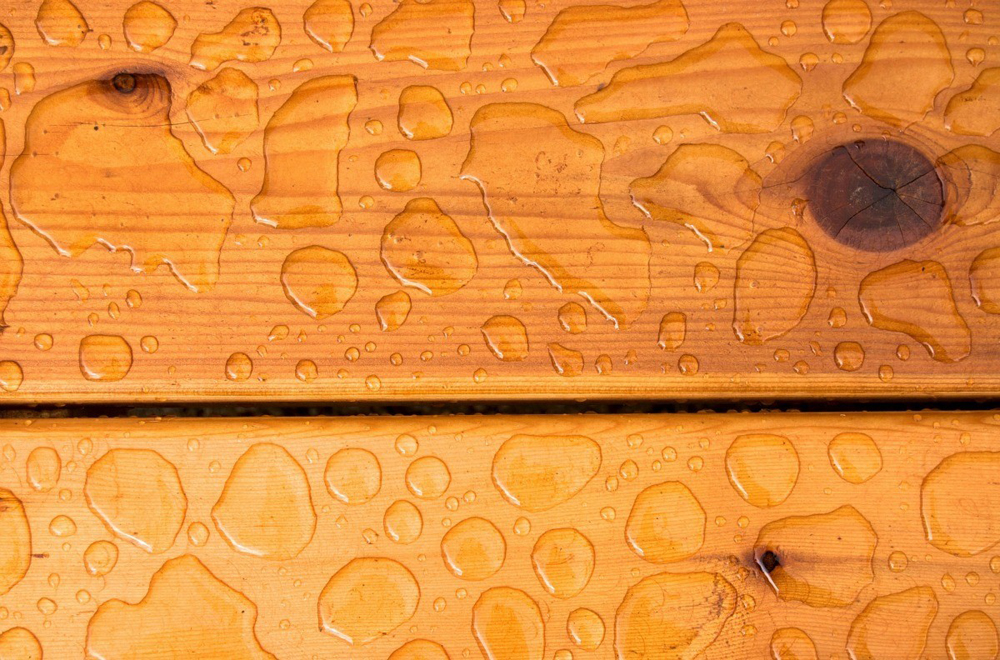
Similarly, in most people’s minds, when a board gets wet, it is wet the whole way through. This is only what our eyes are telling us.

In truth, it’s only the surface that gets wet (usually the top 1mm), the rest of the board stays perfectly dry.

To apply a Cedar coating, we only need the surface of the board to dry out. Depending on exposure to the sun, wind and air temperature, this can happen anywhere between 5 – 30 minutes.

You can feel whether Cedar it is dry or not by touching the boards. If the surface is too wet, we simply do not apply the coating.

Mark likes to use the analogy of hanging out washing. If you are happy to put out your washing to dry, you can coat Cedar.

And if a spattering of rain does get onto the surface, the oil or stain is already working to create a barrier against moisture.

What Happens if it Does Rain?

Every morning, the Senior Technicians assigned to the job will look at the weather and work with the Production Manager to make the call. In most cases, the decision has been made the previous day.

Our scheduling team also looks at the weather in advance and plans accordingly. If rainy weather is on the way, they will book in other work such as washing or adapt the scheduled work to the conditions.

If the weather is inclement, the technicians can focus on areas of the house away from the wind and rain.

If the weather is coming from the north, we can coat the areas on the south, or undercover areas.

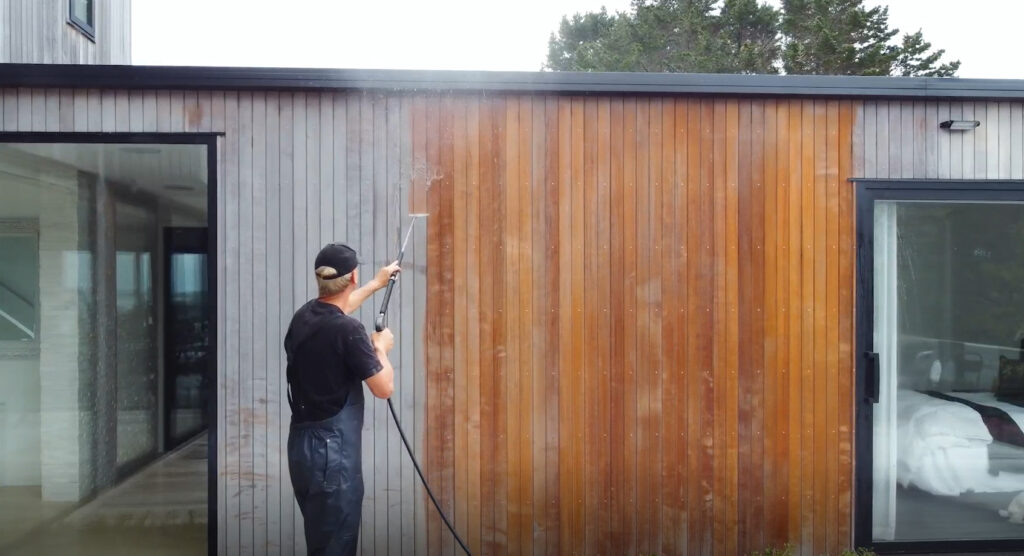
If rain is truly setting in, we can wash the Cedar in preparation for coating. During periods of persistent rain, there can be a gap of 1-2 weeks between washing and coating, but this could be left up to 6 weeks without any issues.

So, When is the Best Time to Coat?

The answer is always now. If you ask us in 6 weeks or 6 months, the answer will be the same.

We are battling the sun here, and the sun always wins. New Zealand’s harsh UV rays are constantly sucking the natural tannins from the boards and they need to be coated to protect against the wet-dry-wet effect.

If left longer than the recommended 2-3 summers, the surface can begin to roughen and create a toe-hold for mould and lichen, resulting in an unkempt look.

This isn’t scaremongering. If you leave them for another 6 months, the difference is almost indiscernible. But that doesn’t change the fact that there is no “best time” for Cedar maintenance.

The best time is always now. You just need to pick your days.

Final Thoughts

We have been doing this for over 30 years and know our way around a bit of rain.

If the boards are dry, we can coat them. Once we get to the point where the boards are wet and will not dry, we stop. Simple as that.

Don’t let the idea of rain put you off getting your Cedar maintained and protected. Winter is just as good as summer, and autumn is just as good as spring. The sun never stops and neither do we!

Does Your Cedar Need Help?

Our Free Cedar Assessment will assess the health of your timber and give expert advise on how to keep it looking beautiful for years to come.

Cedar stain to oil after

Read More Articles

12 Aug 2023
What debate? Oil is the way to go when it comes to cedar, no contest. While stain only coats the surface of the wood, oil works in partnership with one of cedar’s basic features. You see, cedar is a naturally oil-rich timber itself – it soaks up rejuvenating oil deep into its cells for up to a year after it’s applied.

“Should I use oil or stain on my Cedar?”

This is by far the most common question we get from Cedar homeowners and a source of some debate on the internet.

In our opinion, there is no debate (with a few caveats). For nearly all situations, treat Cedar with a penetrating oil such as Wood-X.

Oil works like moisturiser for Cedar, deeply replenishing the natural oils and keeping the Cedar protected – and looking great – for many years to come.

So, there we have it, debate closed. Oil is the way to go when it comes to Cedar, no contest. But if the answer is so clear cut, where does this debate come from in the first place?

To find out, read the full article, or watch the video below for a quick summary.

With Cedar, Location Is Everything

If we were having this conversation in the northern hemisphere, the answer would be the opposite: use a stain. Stains last longer and you will have a lot less maintenance over the lifetime of the Cedar.

In New Zealand, the situation is very different. We have some of the harshest UV rays in the world which extract the natural oils from the Cedar and dry out the boards. Over time, the boards will cup and eventually crack, leading to a costly replacement of your cladding.

Stains protect the boards from moisture and look great, but unlike penetrating oils, they do not replenish the natural oils extracted by the sun. They are designed to erode over time, often unevenly, and leave the timber unprotected and unsightly.

Caveats For Using Stain on Cedar

While oil is recommended for Cedar in nearly all cases, there are some situations where stain is more suitable.

If the Cedar has considerable shade with little to no UV exposure, using a stain instead of an oil might be appropriate. This is usually when a house is shaded by dense tree cover or has wide soffits, such as villas where the roof extends over the porch.

The soffits stop the weatherboards from being degraded by the sun. These well protected areas can be treated with a stain and will look great forever.

If in doubt, get in touch, we are always happy to give an expert opinion on which treatment is best for any given job.

Comparing Costs Between Cedar Oils and Stains

Over the long term, there isn’t much difference in maintenance cost between oils and stains. The real savings come when looking at the longevity of the Cedar boards over the lifetime of your home.

Stained Cedar will dry out in the sun, causing the boards to cup and warp faster, and increase the likelihood you will need to replace your boards. A costly solution to an avoidable problem!

The difference shows up when we’re preparing Cedar for restoration. Sanding stain may reveal unsuspected insect, sun or moisture damage. With an oil recoat on a well-maintained property, it’s just a gentle clean with a bio-degradable wash, a short drying period and the re-oiling itself.

Have any more oil vs stain questions? Send us a message or use the Live Chat below!

14 Jun 2023
Cedar is a miracle timber if ever there was one: durable, long lasting, rot resistant and a superior insulator – warm in winter and cool in summer. Not to mention it looks stunning.

Congratulations on purchasing your newly built Cedar home! 

Cedar is a miracle timber if ever there was one: durable, long lasting, rot resistant and a superior insulator – warm in winter and cool in summer. Not to mention it looks stunning. 

But like any outdoor timber, Cedar will require maintenance to stay in optimal condition.  

New Zealand’s UV rays are some of the harshest in the world and they will eventually dry out the Cedar, leading to fine cracks and a roughening of the surface. This can commonly be seen in Cedar houses that have been left to “silver off”. 

By starting Cedar maintenance early, you can get ahead of costly maintenance further down the line and keep your cladding looking just as beautiful as the day you moved in. 

When To Start Cedar Maintenance

We recommend starting Cedar maintenance after two summers. 

At this point, you may be wondering why we are talking about maintenance for a house that has just been built two years ago? Fair question! 

While fresh Cedar boards do have a reservoir of natural oils that will keep them protected for longer, the boards have now been exposed to the sun for two summers and the natural oils are already being depleted. 

It’s also worth noting that although you just recently moved, the Cedar may have been installed up to 3-6 months before that, so this process is well underway. 

What Does Cedar Maintenance Involve?

For most new Cedar homes, maintenance consists of a soft wash and a recoat of sun exposed areas. 

Our soft wash is an oxy-wash solution that removes any built-up organic matter – dust, pollen and spores – and leaves the Cedar fresh and vibrant. 

Applying a recoat of oil will replenish the Cedar’s natural oils, fortify existing anti-fungal properties and enhance the colour tone, retaining the vibrant look of freshly installed Cedar. 

After the initial treatment, sun exposed areas need to be maintained every 2-3 summers. The rest of the house may not need any maintenance for 5-7 years, apart from a light wash to remove built-up organic matter. 

How Much Does Cedar Maintenance Cost?

This depends on the house size, ease of access and if scaffolding is required, but as a rough guide, the initial treatment of a single-story house with good access can cost anywhere between $4-5k.  

A larger house with multiple stories can cost anywhere between $8-9k, plus you may need to include the cost of scaffolding on top of that. 

However, after the initial treatment of the whole house, the cost of regular maintenance drops by 40-50% as only the sun exposed areas need maintaining. 

If you have bought a Cedar house in a new development, chances are you are in the same maintenance schedule as the houses around you. By pooling together with your neighbours, we can often spread fixed costs (such as a cherry picker) across the all the involved parties. 

Protecting Your Investment

A new house is an investment, possibly the most expensive investment you will ever make.  

By regularly maintaining your Cedar, you are protecting the long-term value of your property and investing money now to get a higher resale value if you decide to sell. 

Regular maintenance is also more cost effective than undertaking restoration just before you are ready to sell – and you will get to enjoy the beautiful look of freshly maintained Cedar while you are still actually living there! 

15 Apr 2023
You might be surprised that there’s no ‘best time’ for treating Cedar and maintenance can be done throughout the year, across all seasons, given there is enough time for the oil to penetrate the timber, or the stain to cure. The real question isn’t which season is best for maintaining Cedar, but which conditions are optimal for the Cedar maintenance process.

You might be surprised that there’s no ‘best time’ for treating Cedar and maintenance can be done throughout the year, across all seasons, given there is enough time for the oil to penetrate the timber, or the stain to cure. 

We usually get asked this question during winter, when the weather outside is either rainy, cold, blowing a gale – or sometimes all three at once! 

In fact, winter is an excellent time for Cedar maintenance. Your cladding has been knocked about by the summer sun and needs nourishment, relief and protection. 

The real question isn’t which season is best for maintaining Cedar, but which conditions are optimal for the Cedar maintenance process. 

To find out more, read the full article, or watch the video below for a quick summary.

Optimal Conditions for Cedar Maintenance

To successfully apply oil or stain to Cedar, the boards need to be dry, with no threat of imminent rain. It’s that simple. 

When most homeowners think of maintaining the outside of their house, they think of paint and how long it takes to dry. Oil and stains do not work like paint and are quick drying.  

On a hot summer’s day, we can stain the side of a house and gently waterblast it 20 minutes later and the stain won’t move. 

Oils are similarly robust. On average you want to give oil a couple of hours to soak in. Once absorbed into the timber, the oil is resistant to any incoming rain and is in no danger of getting washed away or having the finish ruined. 

The Best Plan is Planning Ahead

If last summer is any indication, heavy rain can strike at any time, as can long dry stretches.  

Given our changing weather patterns, there really isn’t an ideal time to maintain Cedar and the best course of action is to get your Cedar regularly maintained, following our standard advice. 

“To protect Cedar from the harsh NZ sun and keep it looking beautiful year-round, sun exposed areas should be treated at least once every 2-3 years.” 

So don’t let winter deter you from getting your Cedar maintained. Our Cedar Technicians are experts in their field and know how to work around the seasons, even if there are four of them in one day! 

Read More Articles

Showing 1 - 10 of 18

Subscribe

Sign up to our quarterly newsletter for all the latest Cedar tips and expert advice.